
How can finance for land restoration and resilient land and water systems be transformed and scaled? The new GLO3 Working Paper by ELD and UFZ explores why transforming the financial architecture is essential to achieving global land targets and unlocking investment in sustainable land use, what needs to be done and how change can happen.
The GLO Working Paper “Financing Land: Transformative Pathways to Resilient Futures” was launched at UNCCD COP17 in Ulaanbaatar, Mongolia. Developed by the ELD Working Group and wider ELD Network under the leadership of Lead Authors Alisher Mirzabaev (CGIAR-IRRI, UNCCD SPI member), Prof. Bernd Hansjürgens (UFZ) and Johannes Kruse (ELD/GIZ), the paper brings together contributions from experts across the ELD network and beyond. It provides the basis for the financing chapter of the forthcoming Global Land Outlook 3.
From a financing gap to a transformation of the financial architecture
Implementing countries’ global commitment to restore 1 billion hectares of land is not only an ecological necessity, but also represents a major economic opportunity. New evidence presented in the Working Paper suggests that implementing existing restoration commitments could generate an additional USD 4.4 trillion in annual ecosystem service value. Restoring all feasible land could increase this opportunity to USD 24.6 trillion per year.
At the same time, land and nature face a financing gap of at least USD 355 billion per year. The challenge, however, is not simply to mobilise more capital. It also requires a structural transformation of the financial architecture: harmful financial flows and incentives need to be phased out, while the enabling conditions for scaling investment in sustainable land use, restoration and resilience need to be strengthened.
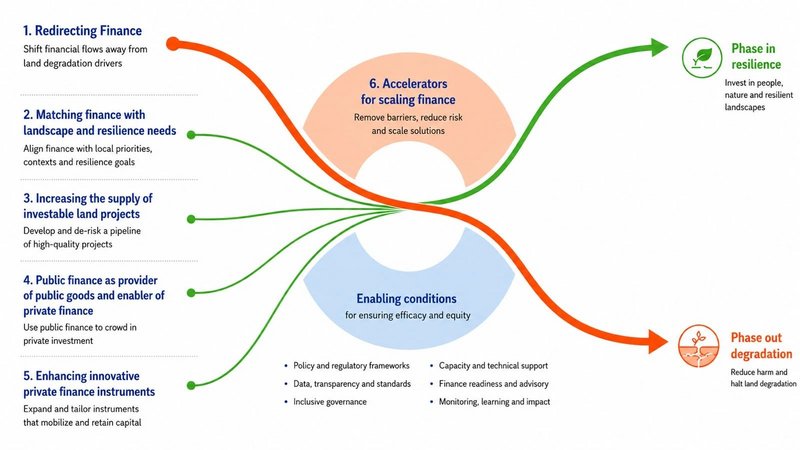
The Working Paper identifies six transformation pathways to support this shift:
- Redirect finance to phase out degradation, including harmful subsidies.
- Match financial instruments with landscape and resilience needs.
- Increase the supply of investable projects and strengthen project pipelines.
- Strengthen public finance as a provider of public goods and an enabler of private investment.
- Enhance innovative private finance, including blended finance, impact investment, green bonds, sustainability-linked loans, supply-chain finance and insetting.
- Strengthen enabling conditions and accelerators, including conducive policy environments, to scale finance.
The paper also highlights the importance of ensuring that financial flows translate into tangible benefits for people, land and nature, supported by the right institutional, policy and governance conditions.
Seven case studies from around the world
Seven practical case studies illustrate how these transformation pathways can be put into practice in different contexts. They include agricultural subsidy reform in Colombia, Georgia and Thailand; transformational agroecology in Burkina Faso; blended finance for restoration landscapes; public grants supporting restoration and rural enterprise; ecological fiscal transfers in Indonesia, Malaysia and Uganda; blended finance approaches in Spain; and a stacked-income model for financing land restoration in Colombian coffee landscapes.
Together, the cases demonstrate that, with the right combination of financial instruments, governance and enabling conditions, the transition towards resilient land and water systems is both feasible and capable of creating new economic opportunities.