
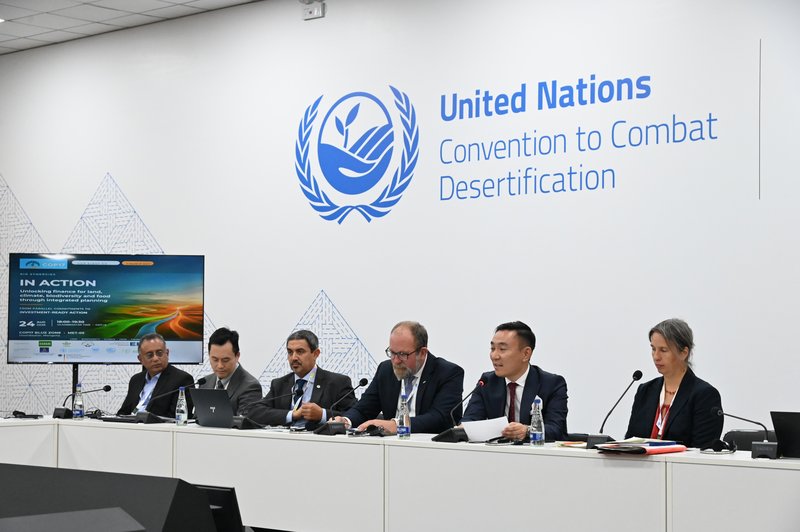
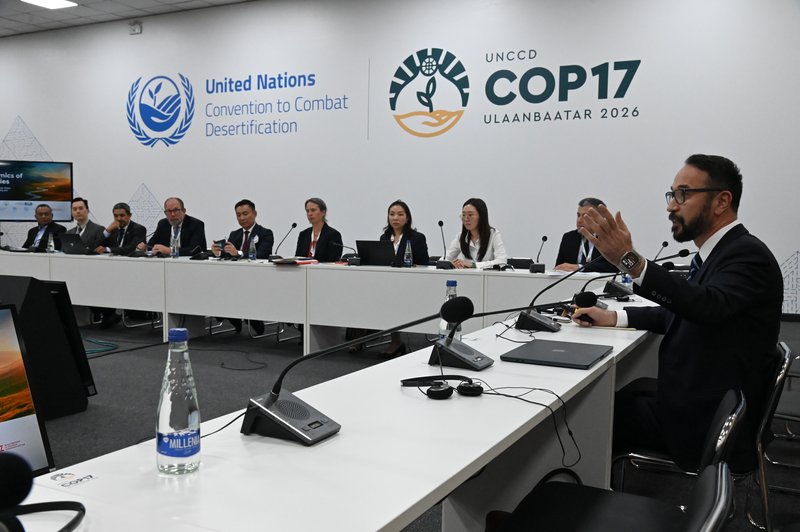
At UNCCD COP17 in Ulaanbaatar, Mongolia, the side event “Rio Synergies: Unlocking Finance for Land, Climate, Biodiversity and Food through Integrated Planning” brought together representatives from governments, international organisations, development finance, research and the private sector to explore how integrated approaches can unlock investment for land restoration, climate action, biodiversity and food security.
The event highlighted a key challenge: while land degradation, climate change, biodiversity loss, food security and rural livelihoods are closely interconnected, they are often addressed through separate institutions, planning processes, financing mechanisms and reporting systems. This siloed approach can increase transaction costs and make it more difficult to mobilise and use finance effectively.
From policy synergies to investment opportunities
Drawing on findings from the Economics of Rio Synergies project in Mongolia, speakers highlighted how integrated land-use planning can connect national commitments with concrete, spatially targeted investment opportunities. To attract finance, restoration initiatives need to go beyond identifying synergies: they need to translate scientific evidence and local knowledge into costed, geographically specific and investment-ready proposals with clear expected returns, institutional ownership and measurable outcomes. The Mongolia study demonstrates the economic potential of integrated land restoration and highlights the scale of investment opportunities:
- US$2.5 billion per year – estimated cost of inaction from land degradation.
- 94% of assessed degraded areas – economically viable for restoration over a 30-year horizon.
- US$8.66 billion – estimated investment requirement for restoration.
- US$1.77 generated per US$1 invested on average, with returns of up to US$5 per dollar for wetlands and US$2 for grasslands.
- 9 years – average estimated break-even period for restoration investments.
- Up to 17% efficiency gains – possible through more integrated implementation across sectors and interventions.
- Around US$1.2 billion – potential savings or additional restoration resulting from these efficiency gains.
- Around 40% of project costs – transaction costs accounted for in existing and past projects, highlighting the potential gains from better coordination.
- 30–50% of restoration costs – linked to salaries and wages, underscoring the potential contribution of restoration investments to local employment and livelihoods.
Together, these findings suggest that integrated land-use planning can help turn restoration commitments into concrete, geographically targeted and finance-ready investment opportunities.
Mobilising the right finance for the right interventions
The discussion also emphasised that not every restoration activity will be commercially bankable. Public and concessional finance remain essential for activities that generate public goods, such as biodiversity conservation, while revenue-generating activities may be suitable for private and commercial capital. Blended finance can help bridge these different financing needs.
Making restoration investment-ready requires clearly linking interventions to political priorities such as jobs, food and water security, climate resilience and biodiversity; identifying specific locations, costs and expected returns; structuring finance according to the type of activity; and establishing clear institutional ownership.
The event also stressed that integrated planning cannot rely on economic and technical analysis alone. Local communities, pastoralists, government institutions and other stakeholders need to be involved so that local knowledge, social priorities, non-economic values and human rights considerations are reflected in investment and planning decisions.
The side event was organised by IRRI-CGIAR in partnership with Mongolia’s Ministry of Environment and Climate Change, the Mongolia Green Gold Rangeland Research Center, GIZ/the Economics of Land Degradation Initiative, GIZ Mongolia, FAO and the secretariats of UNCCD, UNFCCC and CBD, with support from the German Federal Ministry for Economic Cooperation and Development (BMZ).