The Business Case for Land
About the project
More than $44 trillion – over half of global GDP – is highly or moderately dependent on nature. At the same time, land degradation and climate-related pressures are putting this economic foundation at risk. Land degradation has already reduced the productivity of around 23% of the global land surface since 1970.
For businesses, these trends translate into very tangible risks – from declining productivity and resource availability to disrupted supply chains and higher operating costs.
The impacts can become particularly severe under drought: severe droughts reduce yields by around 20% on average, with the impact potentially doubling on severely degraded land.
But this is also an opportunity. Investing in healthy soils, resilient landscapes and sustainable land management can help businesses reduce risks, strengthen supply chains, secure long-term resources and identify new investment opportunities.
BUILDING PRIVATE-SECTOR CAPACITY FOR SUSTAINABLE LAND MANAGEMENT AND RESTORATION
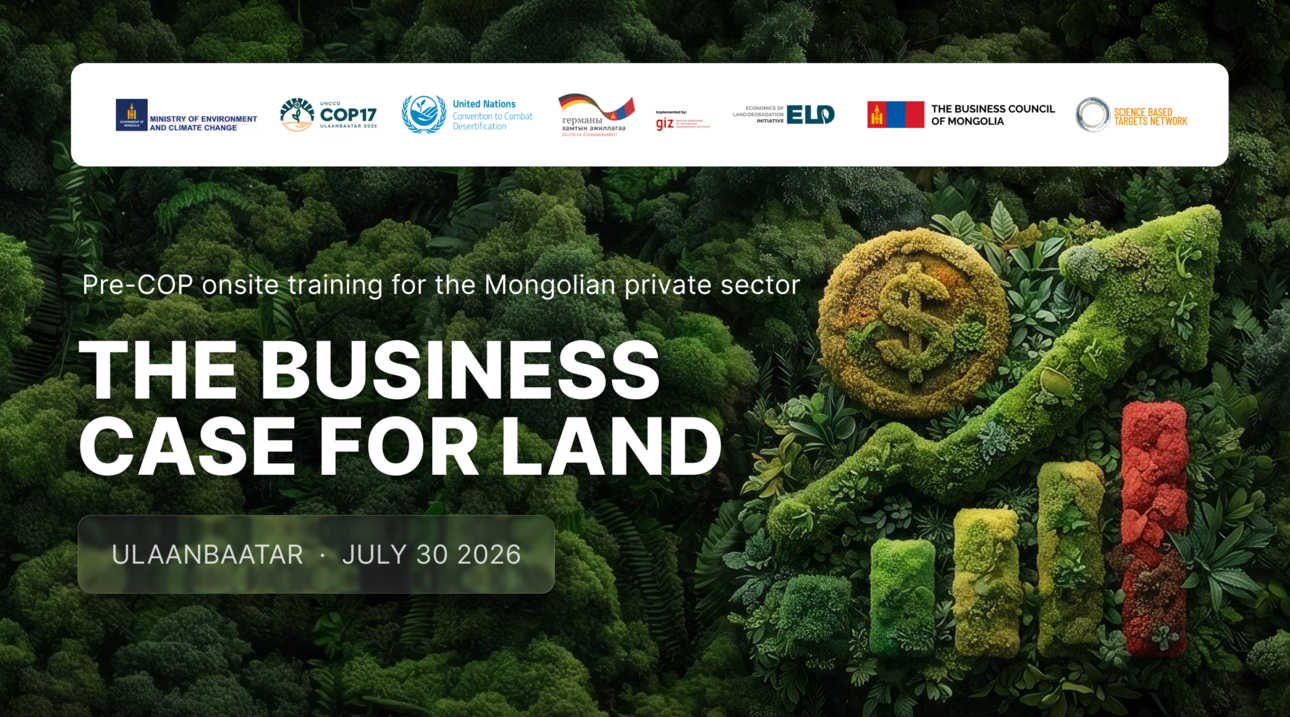
The Economics of Land Degradation (ELD) Initiative, the UNCCD Business for Land (B4L) Initiative and the bilateral GIZ Project SPACES II have joined forces to develop a new capacity-development programme for the private sector: “The Business Case for Land.”
Meet the programme at UNCCD COP17
Three teaser sessions will introduce the training and give businesses space to explore how land-related risks and opportunities bear on their own operations and strategies. All sessions take place at the B4L Pavilion, UNCCD COP17, Ulaanbaatar. Times are local (ULAT, UTC+8).
- Session 1 — Tuesday 25 August 2026, 15:00–16:00
- Session 2 — Wednesday 26 August 2026, 12:30–13:30
- Session 3 — Thursday 27 August 2026, 14:00–15:00
Walk-in hours: 25–27 August 2026, 16:30–17:30. Drop in to talk through the materials with the team, no registration needed.
Land is a critical economic asset for businesses across sectors. Yet land-related risks, dependencies and opportunities are often insufficiently understood and integrated into business decision-making. The training addresses this gap by connecting land, business performance, resilience and investment and demonstrating how sustainable land management and restoration can create value while reducing risks.
The training is designed around the questions and needs of different private-sector functions and brings together economic approaches, practical tools and relevant frameworks. Rather than treating land as an additional sustainability topic, it frames land as a strategic business issue linked to risk management, enterprise value, supply-chain resilience and investment.
The training is built as five modules. Together they form a single learning journey; individually they stand alone, and they can be re-sequenced or compressed into shorter formats.
- Module 1 — The economic case for land. Why does land matter to my business and my balance sheet?
- Module 2 — Risks and opportunities. Where might I be exposed, and where is the upside?
- Module 3 — Assessment tools. How do I assess and value land action?
- Module 4 — Investment and finance. How do I fund it, and what makes it bankable?
- Module 5 — Action and accountability. How do I set targets and contribute to national LDN?
Every module can be weighted toward the function most relevant to the room, so that each participant group finds its own entry point:
- Corporate Sustainability & ESG — understanding and managing land-related impacts, dependencies, risks and targets
- Finance & Investment — assessing economic returns, financial risks and opportunities, and exploring financing options
- Procurement & Supply Chains — strengthening sourcing strategies and integrating land resilience into value chains
- Operations & Land Management — translating commitments into practical action on the ground
The programme has been piloted in Ulaanbaatar, Mongolia, with national private-sector actors. The training materials are designed to be scalable and adaptable beyond COP17, providing a practical resource for businesses and partners seeking to integrate sustainable land management, restoration and drought resilience into decision-making.
>> More information and training materials will be published soon after COP17 <<