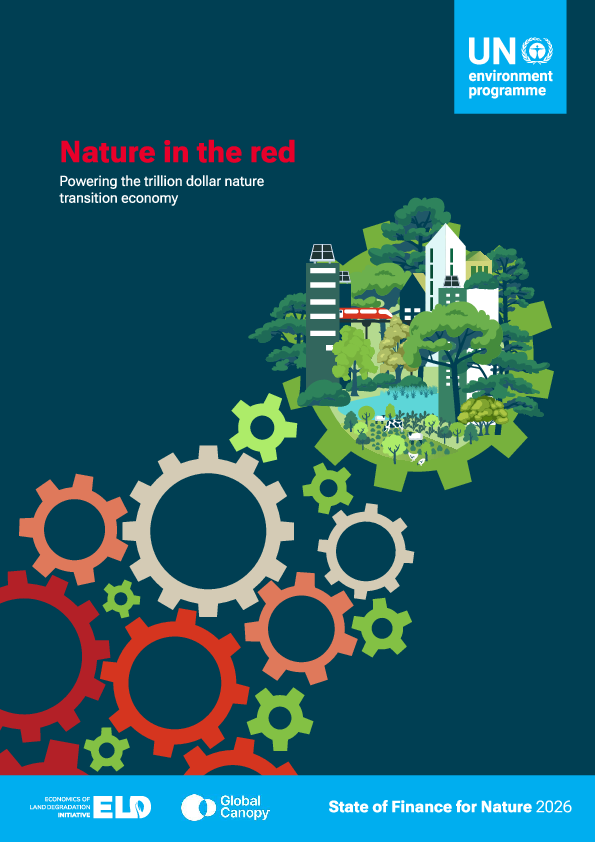
For every US$1 the world invests in protecting nature, it spends US$30 on destroying it.
This stark imbalance is the central finding of the new State of Finance for Nature 2026 report produced by UN Environment Programme in collaboration with the Economics of Land Degradation (ELD) Initiative and Global Canopy.
The report calls for a major shift in global financial flows towards Nature-based Solutions (NbS) and for the rapid phasing out of harmful investments that undermine ecosystems, resilience and long-term economic prosperity. It shows that aligning finance with nature can deliver high returns, reduce risk exposure and strengthen social and ecological resilience.
Using data from 2023, The State of Finance for Nature 2026 finds:
- US$ 7.3 trillion in total nature-negative finance flows, including
- US$ 4.9 trillion from private sources, highly concentrated in a few sectors such as utilities, industrials, energy and basic materials; and
- US$ 2.4 trillion in environmentally harmful public subsidies, notably in fossil fuels, agriculture, water, transport and construction.
- US$ 220 billion in NbS finance flows, with nearly 90% coming from public sources, reflecting a steady rise in domestic and international support for NbS.
- Private investment in NbS amounted to only US$ 23.4 billion, representing just 10% of total NbS investments. Business and finance have yet to invest at scale in NbS despite growing awareness of dependencies, risks and opportunities related to nature.
- NbS investments need to grow 2.5-fold to US$ 571 billion per year by 2030, corresponding to just 0.5% of global GDP (2024).
Since reforming and repurposing private and public capital flows is the most powerful lever to shift markets towards sustainability, the report introduces a new Nature Transition X-Curve. This framework helps policymakers and businesses sequence reforms by simultaneously phasing out harmful subsidies and destructive investments while scaling up high-integrity NbS and nature-positive finance across all sectors of the economy.
The X-Curve charts a pathway towards a ‘trillion-dollar nature transition economy’ and provides concrete options for both public and private actors along global supply chains. The report highlights examples already being implemented worldwide, including greening urban areas to counter heat stress, embedding nature in transport and energy infrastructure, and producing emissions-negative building materials using carbon dioxide.
A core principle underpinning nature-positive investments is that they must be grounded in local ecological, cultural and social contexts, while ensuring inclusivity and equity. This aligns closely with ELD’s mission to make the economic case for sustainable land use by valuing ecosystems as productive assets for people and nature alike.