
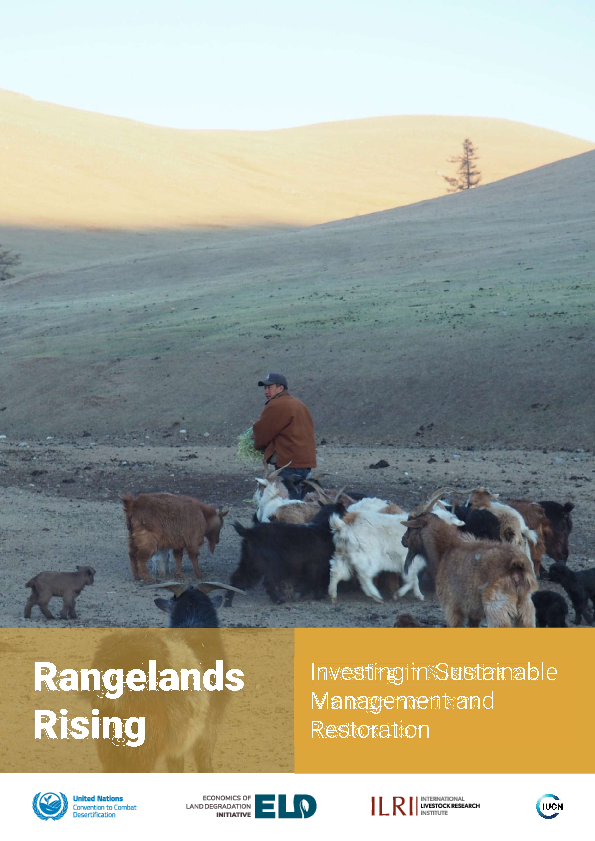
New global report launched at UNCCD COP17 highlights the economic value of rangelands and calls for greater investment in their sustainable management and restoration.
Rangelands cover more than half of the world’s land surface and generate an estimated US$21–47 trillion in benefits every year. They support food production, biodiversity, carbon storage, water regulation and the livelihoods of around 500 million pastoralists. Yet their economic and environmental value remains largely invisible in investment and policy decisions.
Launched at UNCCD COP17 in Ulaanbaatar, Mongolia, Rangelands Rising: Investing in Sustainable Management and Restoration makes the economic case for recognizing rangelands as a critical global asset and investing in the people who manage them. The report is jointly published by ILRI, GIZ, the Economics of Land Degradation Initiative, UNCCD and IUCN.
Key findings
- Rangelands are highly valuable but significantly undervalued and underinvested, despite their contributions to food systems, biodiversity, water, carbon storage and livelihoods.
- Restoration can deliver strong economic returns, with returns often exceeding 4:1, while early action on lightly to moderately degraded rangelands can be considerably more cost-effective than restoring severely degraded land.
- Pastoralists are already frontline investors and stewards, contributing labour, knowledge, livestock and resources, but often capture only a fraction of the wider benefits their management generates.
- Governance and secure land rights are essential for successful investment, alongside strong local institutions and inclusive decision-making.
- Blended finance and public investment can help unlock private capital by reducing risks and addressing governance, tenure, infrastructure and monitoring challenges.
- Rangelands offer major opportunities for climate resilience, combining mitigation, adaptation and drought resilience across more than half of the world’s land.
- Scaling restoration requires a shift from reactive to proactive investment, including greater integration of rangelands into national budgets, climate commitments and long-term restoration strategies.
The report calls for a shift from seeing rangelands as marginal or degraded landscapes towards recognizing them as productive, valuable and investable ecosystems. Scaling action will require coordinated investment, stronger governance and greater recognition of pastoralists as rights-holders, stewards and co-investors.
Rangelands Rising contributes new economic evidence to the growing global momentum around rangeland restoration, including the UNCCD Rangeland Flagship Initiative, and provides recommendations for governments, investors, development partners and restoration practitioners.